 EN
Exfoliating Cotton Pads: Innovations in Skin Care
The global cotton pads market reached approximately USD 845 million in 2024 and continues its upward trajectory, driven by rising consumer awareness of daily skin care routines. Within that broader category, exfoliating cotton pads have emerged as one of the more technically interesting subcategories, and substrate innovation here is moving faster than most buyers realize.
Working closely with nonwoven raw materials, I've watched exfoliating cotton pads evolve considerably over the past several years. What was once a commodity item — a flat disc of cotton — has become a platform for embossed textures, dual-layer constructions, and certified sustainable materials. Whether these innovations actually deliver measurable improvements in skin care outcomes, or whether they're mostly packaging stories, deserves a closer look.
The Evolution of Exfoliating Cotton Pads in Modern Skin Care
Traditional cotton rounds served a straightforward purpose: remove makeup, apply toner, or wipe the skin clean. Exfoliating cotton pads broadened that function by introducing physical exfoliation as a secondary benefit. Early versions were simple — a slightly rougher weave, or a light emboss that created friction against the skin surface to lift dead cells and improve product penetration.
What's changed is the precision. Early textured pads often suffered from inconsistent surface friction across batches. A wave emboss produced with slightly different pressure settings resulted in exfoliating cotton pads that felt noticeably different to consumers — some batches too rough for daily use, others barely distinguishable from standard rounds. That batch-to-batch variability was a real pain point for brands who approved a sample only to receive mass production output with a different tactile profile.
The innovation response has been both material and process-driven. Spunlace nonwoven technology, combined with controlled embossing under standardized pressure parameters, has significantly improved texture consistency across exfoliating cotton pads production runs.
Key Innovations Reshaping Exfoliating Cotton Pads
Dual-Layer and Dual-Texture Construction
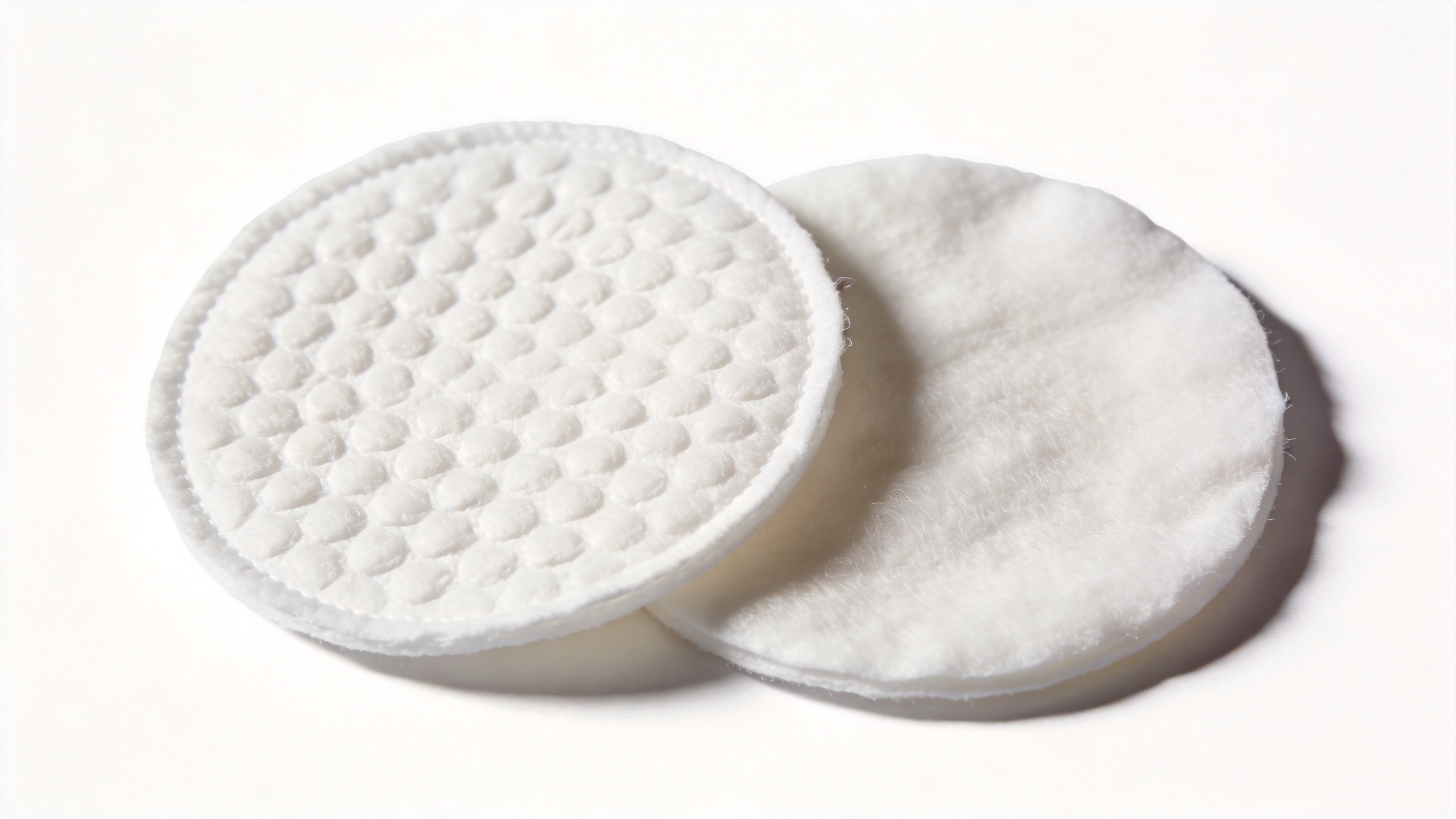
The most commercially successful innovation has been the dual-sided exfoliating cotton pad — one smooth face for toning and serum application, one textured or embossed face for physical exfoliation. This construction gives consumers two tools in a single product, and it lets brands position the same SKU across multiple usage occasions.
From a substrate perspective, the dual-layer approach combines a soft spunlace or pure cotton layer with a textured spunlace layer, bonded to maintain separation of function without adding unwanted bulk. The key specification variables are GSM balance between the two layers, bond strength at the interface, and how the textured layer's friction profile holds up after saturation with toner or serum. Conditional on the bonding process, some early dual-layer exfoliating cotton pads experienced delamination under heavy liquid saturation — a failure mode worth checking during supplier qualification.
Embossed Surface Pattern Variety
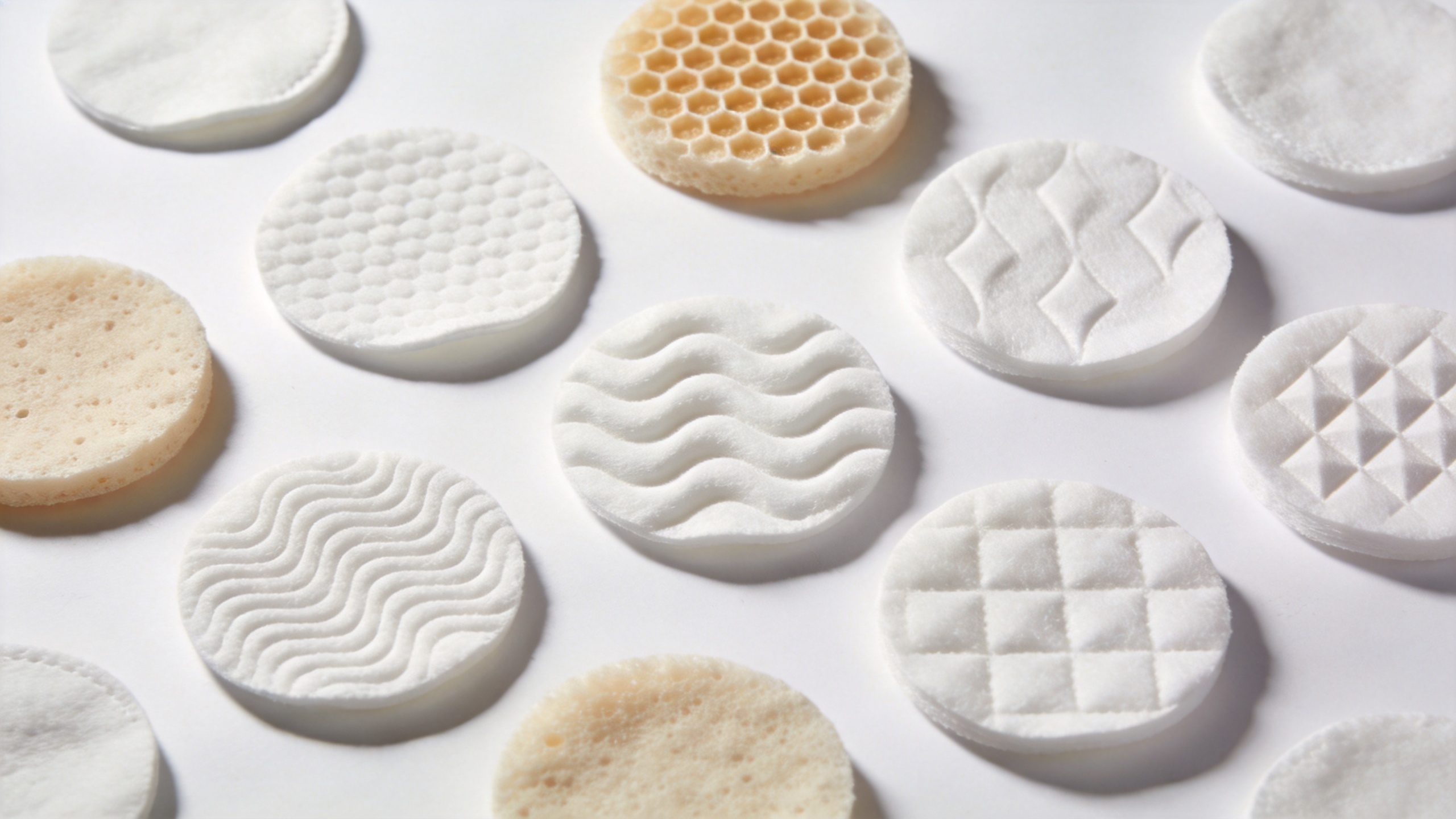
Embossing on exfoliating cotton pads is no longer just "rough versus smooth." Pattern variety — honeycomb, wave, diamond, and other geometric structures — has become a meaningful differentiation pathway for brands. Different patterns create different friction profiles: a honeycomb emboss distributes pressure more evenly across a larger contact area, while a diamond or wave pattern concentrates friction at specific points for more targeted exfoliation.
For OEM buyers, the implication is that embossing pattern selection for exfoliating cotton pads should be driven by the intended skin care outcome and target consumer, not just visual appeal. A pad designed for sensitive skin daily use calls for a different emboss geometry than one positioned as a weekly deep-exfoliation treatment. Suppliers who offer a documented range of emboss options with corresponding friction and skin safety profile data provide brands with a more defensible product development pathway.
Substrate Material Advances
Beyond pure cotton, the materials palette for exfoliating cotton pads has expanded. Spunlace nonwovens made from blended fibers — combinations of cotton, viscose, polyester, and lyocell — allow manufacturers to tune absorption, texture, and durability characteristics more precisely than single-fiber constructions permit.
Lyocell (Tencel) fiber blends have attracted attention in premium segment brands seeking to add a sustainability narrative. The fiber's closed-loop production process supports traceable material origin documentation, which can feed into OEKO-TEX Standard 100 certification applications — a pathway increasingly relevant for brands selling into EU and North American markets where skin-contact material safety credentials carry commercial weight.
What Brand Buyers Should Evaluate in OEM Specifications
Most brand buyers approach exfoliating cotton pads sourcing with a sample-approval model: request samples, evaluate on skin, approve the preferred option, and place the order. That process works reasonably well for standard products but can fall short for textured exfoliating cotton pads, where the variables driving performance — GSM, emboss depth, fiber composition, layer bonding — are not visible in the sample itself.
A more outcome-focused evaluation approach involves requesting specification documentation alongside samples. The key parameters to ask for when sourcing exfoliating cotton pads include:
- GSM and layer breakdown — total weight and, for dual-layer constructions, the individual layer GSMs
- Emboss pattern specification — geometric description, emboss depth in millimeters, and the press parameters used in production
- Fiber composition — percentage breakdown by fiber type, with supporting material certificates if certification claims are being made
- Tensile strength data — wet tensile in particular, since exfoliating cotton pads are typically used while saturated with toner or serum
- Surface friction profile — ideally from standardized testing, though supplier-defined friction classifications are also informative
Suppliers who can provide technical data sheets covering these parameters give brand buyers a documented foundation for quality control across subsequent exfoliating cotton pads production batches.
Sustainability and Certification Considerations
The sustainability dimension of exfoliating cotton pads is more complex than it appears at retail. Brands making biodegradable, organic, or clean beauty claims about their exfoliating cotton pads need those claims to be substantiated by verifiable supplier documentation — not just marketing language from the factory's product page.
OEKO-TEX Standard 100 certification remains the most broadly recognized credential for skin-contact nonwoven materials in global markets. It covers harmful substance testing at every processing stage, which is meaningful for exfoliating cotton pads that contact skin daily. Brands entering EU and North American retail channels increasingly treat OEKO-TEX certification as a baseline rather than a premium differentiator.
For brands with more specific sustainability positioning, the practical advice for sourcing teams is to scope the specific claims their brand intends to make in marketing, then work backward to confirm which of those claims the supplier's existing documentation can support.
Looking Ahead: The Future of Exfoliating Cotton Pads
Substrate development in exfoliating cotton pads is moving toward tighter integration with the active ingredient side of skin care. Pads pre-loaded with mild chemical exfoliants — AHAs, BHAs, or enzyme-based formulations — combine physical and chemical exfoliation mechanisms into a single application format. The substrate specification for these products adds serum compatibility and active stability requirements on top of standard texture and absorption parameters.
Innovation in exfoliating cotton pads shows no sign of slowing. Brands that treat this category as a commodity sourcing exercise are likely to find themselves outpaced by competitors who treat substrate selection as a strategic product development input. The suppliers positioned to support that evolution are those who bring both technical specification capability and proactive formulation compatibility guidance to the OEM partnership.
 Hot News